

Health-Economic Potential of Intestinal Lengthening in Pediatric Short Bowel Syndrome Patients
Pietzsch JB, Garner AM, Krummel TM, Dunn J. The health-economic potential of intestinal lengthening in pediatric short bowel syndrome patients. Poster of distinction, International Pediatric Intestinal Failure and Rehabilitation Symposium, online, June 26, 2020.
Objectives. Intestinal lengthening has the potential to provide substantive improvement in patient outcomes while also reducing downstream utilization of healthcare resources. We conducted a model-based calculation to estimate the potential healthcare system savings associated with defined increases in short bowel length.
Methods. We constructed a decision-analytic model to project costs based on the proportion of patients requiring total parenteral nutrition (TPN), and resulting cost differences over 10 years. The time-dependent proportion of patients on TPN was based on a previous study that reported outcomes for 230 patients. Long-term cohort survival was calibrated to data from the Pediatric Intestinal Failure Consortium. Costs were based on the U.S. Medicare fee schedule for 2019, and were limited to costs for TPN and TPN-related hospitalizations to treat bloodstream infections. In sensitivity analysis, the financial impact of additional use of teduglutide (Gattex) was explored.
Results. The model-projected cost differences for a 1-year-old patient with <10% expected short bowel length for extension by 10–20%, 20–30%, and >50% expected, corresponding to required lengthening of 10–30 cm, 30–60 cm, and >130 cm (Figure 1). The 10-year cost savings were lowest for the <10% to 10–20% group (–$344,000) and highest for the <10% to >50% group on teduglutide (–$2,134,000).
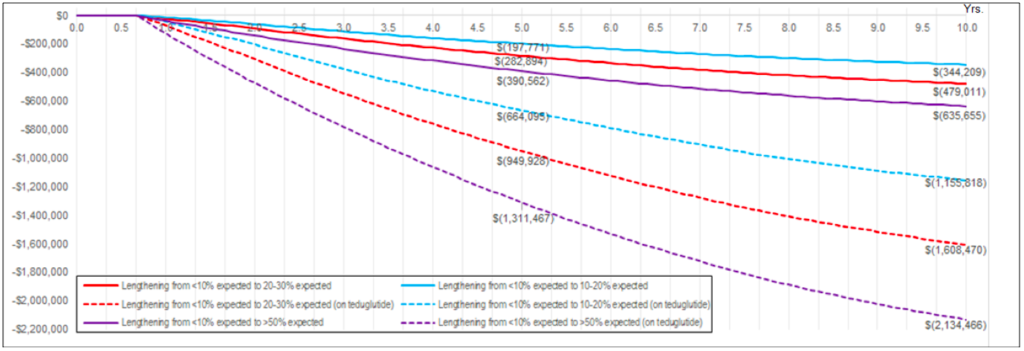
Conclusions. Our model-based projections suggest that successful intestinal lengthening can be expected to lead to substantive improvement in clinical outcomes and, importantly, may also lead to substantial cost savings even after consideration of the cost of surgical or mechanical lengthening procedures.