

An Innovative Alternative to Diverting Ostomy in Rectal Cancer Patients: From a Technical Innovation to a Cost-Saving Perspective
Alavi K, Geisler BP, Komen N, Pietzsch JB. An innovative alternative to diverting ostomy in rectal cancer patients: from a technical innovation to a cost-saving perspective. Presentation at the virtual annual meeting of the Society of American Gastrointestinal and Endoscopic Surgeons, August 11–13, 2020.
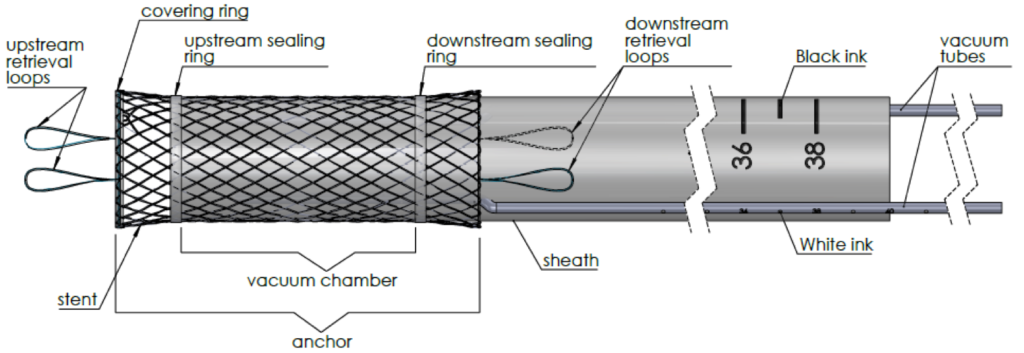
Objective of the Device. The Colovac device is a unique endoluminal bypass sheath placed in the colon following rectal resection, and aimed at reducing any contact of fecal content with the colorectal anastomotic site during its 10-day implantation period (Figure 1).
Description and Method of Use. The Colovac device is anchored upstream of the anastomosis, using a unique double stent combined with an innovative vacuum-based mechanism. It is seamless, minimally invasive, and fully reversible. It can remain in place until the body’s natural healing and tissue repair processes are complete. It is easily removed by means of an endoscopic procedure, avoiding a second surgical intervention.
Colovac placement postpones the decision to perform diverting stoma until anastomotic healing can be assessed, and selectively reserves the use of diverting stoma for only those patients with evidence of incomplete anastomotic healing.
Preliminary Results. A 2019 study published in Surgical Endoscopyreported first-in-human study results demonstrating that the Colovac device provided effective protection of the anastomosis in 12/15 (80%) of subjects during the implantation period, and allowed avoidance of ostomy creation in 10/15 (67%) of subjects.
We conducted a health economic analysis to estimate the potential benefits associated with stoma avoidance in the U.S. healthcare system. First, we estimated the current per-patient costs associated with management of temporary or permanent diverting ostomy for mid- and lower rectal adenocarcinoma patients undergoing sphincter-preserving resection. Second, we created a decision-analytic model to project the lifetime costs for a cohort of patients with an average age of 63 years (range 50 to 80 years) of whom 60% were male, based on a retrospective analysis of the status of 125 patients after sphincter-preserving rectum resection. Lifetime survival was projected via 3-year data from the National Cancer Institute’s Surveillance, Epidemiology, and End Results (SEER) program, calibrated to U.S. lifetables. The costs of monthly stoma care and stoma reversal were based on 2019 U.S. Medicare reimbursement rates. Based on retrospective study data, we assumed that 88% of stomas would be reversed (95% confidence interval [CI]: 81%; 93%). Conservatively, no adverse event costs were considered. Costs were discounted with the usual 3% per year as per economic guidelines. Sensitivity analyses were conducted to evaluate changes in all assumptions.
The aggregated lifetime costs of stoma care and potential reversal were $12,461 per patient. For patients in whom stoma was reversed, costs were $11,208; lifetime costs for ostomates not undergoing stoma reversal totaled $21,652. Varying the reversal rate within the range of the 95% CI led to aggregated costs between $13,192 and $11,939. Varying cohort age led to costs between $14,343 and $10,068 for a 50-year-old and 80-year-old patient cohort, respectively.
Conclusions. The Colovac device provides a unique approach aimed at reducing the need for diverting ostomy in rectal cancer patients. While data collection is ongoing, the evidence to date supports the feasibility of the approach and underscores the clinical need and health economic potential of this emerging technology.