

An Assessment of Annual Procedure Volumes and Therapy Adoption of Transcatheter Closure of Patent Foramen Ovale in Four European Countries
Pietzsch JB, Geisler BP, Daniels MJ, Busca RM, Tarantini G, Søndergaard L, Kasner SE. An assessment of annual procedure volumes and therapy adoption of transcatheter closure of patent foramen ovale in four European countries. Eur Stroke J. June 12, 2020; doi: 10.1177/2396987320939804.
Objectives. Patent foramen ovale closure reduces the recurrence of cryptogenic ischemic stroke compared to antiplatelet therapy. Our goal was to determine procedure volumes and closure utilization as a proportion of candidates in four large European countries.
Methods. National statistics were obtained for England, France, Germany, and Italy for the latest available 5 years (2014–2018). Eligibility was aligned to the enrollment criteria of pivotal trials and current consensus documents. Stroke and transient ischemic attack incidences were obtained from epidemiological registries and claims data. The pool of candidates eligible for analysis included current year candidates plus untreated patients from the prior 2 years. Our calculation of absolute strokes avoided assumed the hazard ratio for ischemic stroke recurrence from a recent meta-analysis.
Results. In 2018, closure incidence rates per 100,000 candidates were 0.53, 2.94, 5.64, and 5.26 in England, France Germany, and Italy, respectively. These rates reflect 5-year increases of 462% in France, 128% in Germany, and 36% in Italy (p <0.05 for all), and a decline of 37% in England. The proportions of treated patients versus candidates for the combined stroke and transient ischemic attack pool were 6% for England, 30% for France, 55% for Germany, and 80% for Italy (Figure 1).
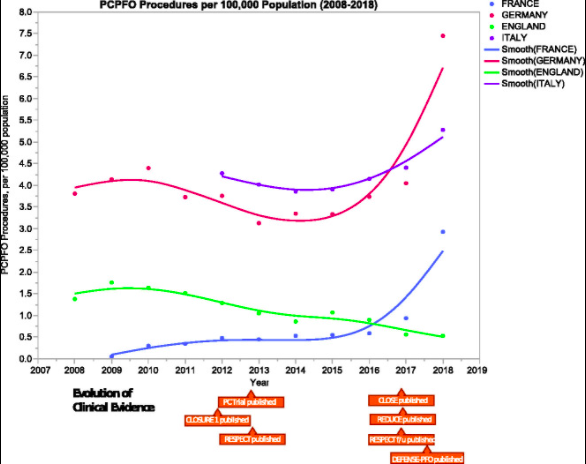
Figure 1. For 2018, the volume of percutaneous patent foramen ovale closure procedures among patients younger than 60 years of age, relative to the calculated pool of percutaneous patent foramen ovale closure candidates younger than 60 years of age, in four European countries. For each country, the left column represents the combined stroke and transient ischemic attack candidate pool; the center column represents the stroke candidate pool only (based on epidemiological stroke incidence data); and the right column represents the stroke candidate pool only (based on administrative stroke incidence data). In the absence of Italian age data, the respective estimates assume an age distribution for percutaneous patent foramen ovale closures similar to Germany.
Conclusions. Patent foramen ovale closure volumes increased after the 2017 announcement of positive trial results but still differ substantially across large European countries. If all 2018 closure candidates with prior ischemic stroke had been treated, the resulting absolute reduction in recurrent ischemic strokes, compared to antiplatelet therapy alone, would be between 782 and 2295 across the four countries over 5 years. Many eligible patients at risk for a recurrent cryptogenic event may remain untreated due to regional practice variations.
Keywords. Cryptogenic stroke, equipment and supplies utilization, foramen ovale, health services misuse, ischemic stroke, patent foramen ovale closure, patent, procedures and techniques utilization, underutilization.